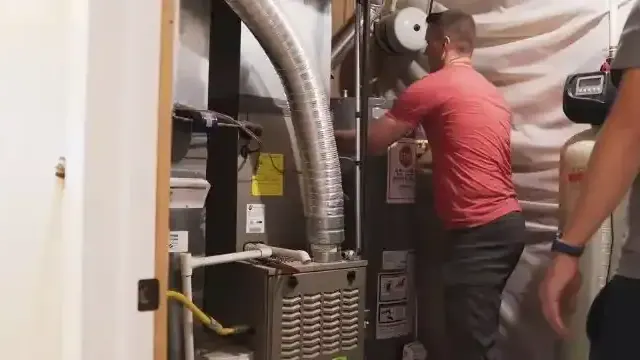
Planned replacement versus emergency replacement
Most water heaters give a warning. Rusty hot water, a rumbling noise, a damp patch at the base or hot water that runs out too soon are all signs that the end is close. Replacing at the first warning lets you choose the unit and book a time.
When the tank fails first, the job becomes an emergency replacement. The steps are the same, only compressed. The plumber confirms the failure, drains and removes the old tank, sets and connects the new one, and tests it before leaving. Same-day replacement is common when the unit you need is in stock, and the dispatcher tells you when it is not.
Choosing the type of heater
The right replacement depends on what is already connected. Swapping a gas tank for a gas tank keeps the existing vent and gas line. Moving from gas to electric or to a heat pump means new wiring, new venting or a condensate drain.
| Option | What changes | Worth considering when |
|---|---|---|
| Standard gas tank | Usually nothing in the vent or gas line | You want the fastest swap. |
| Standard electric tank | Needs a correct breaker and wire size | No gas line is available. |
| Heat pump hybrid | Needs airflow, a drain and a 240 volt circuit | You want lower running cost and have the space. |
| Tankless | New gas line size, venting and a drain | Space is tight and demand is steady. |
A full comparison of the tankless route is on the tankless water heater page. Brand-new installs where no heater existed are covered under water heater installation.
The line is staffed around the clock. Describe what is happening and we dispatch a licensed plumber.
What happens during the replacement
- The plumber confirms the failure and the fuel type.
- Power or gas is shut off and the tank is drained.
- Old water, gas or electric connections are disconnected.
- The new unit is set in a pan with a drain line.
- New flex connectors, a relief valve and the vent or wiring are connected.
- The system is filled, purged, powered and tested for leaks and temperature.
Expansion tanks are checked at the same visit. Where a pressure-reducing valve or a closed system is present, the thermal expansion of heated water needs somewhere to go or the relief valve will drip every cycle.
Water in the basement: emergency steps while you wait
A failed tank can release 40 to 50 gallons quickly. Close the cold valve on the tank, turn off the power at the breaker, and move boxes off the floor. If a floor drain is nearby, it will handle most of the water. If the basement has a sump pump, confirm that it is running. The sump pump repair page covers what to do if it is not.
Take phone photos of the tank and the damage. Your insurer will ask what failed and when, and photos taken before the cleanup save a lot of questions.
Price, permits and what the quote includes
The quote lists the unit, the labor, the venting or wiring work, haul-away of the old tank and any code-required parts. You approve it before work starts.
The Illinois Plumbing Code, 77 Ill. Adm. Code 890, governs how the connections are made, and you can look up any plumber on the Illinois Department of Public Health license lookup before you let them start.
Water Heater Replacement questions
Do you handle water heater replacement emergencies at night or on weekends in Carol Stream?
Yes. The line is open 24/7. After you call, a dispatcher confirms the tank type and arranges a licensed plumber, same day when stock and schedules allow.
How long does a water heater replacement take?
A like-for-like swap is often a half-day job. A fuel change or a heat pump unit with new wiring takes longer.
Do I need a permit to replace a water heater?
Permit rules vary, so ask the Village of Carol Stream building staff. The plumber will tell you what the job normally involves.
What size water heater do I need?
Size depends on how many people use hot water at the same time. A 40 gallon tank suits many small households, and a larger family often needs 50 gallons or more.
Will the old water heater be hauled away?
Yes. Removal of the old tank is part of the replacement unless you tell the dispatcher you want to keep it.
Standards and sources
Plumbing work in Illinois follows the Illinois Plumbing Code, 77 Ill. Adm. Code 890, and plumbers are licensed by the Illinois Department of Public Health under 225 ILCS 320. Local water facts come from the Village of Carol Stream 2025 water quality report and the DuPage Water Commission FAQ. These are the standards and sources we rely on, and anything we could not verify is left out.