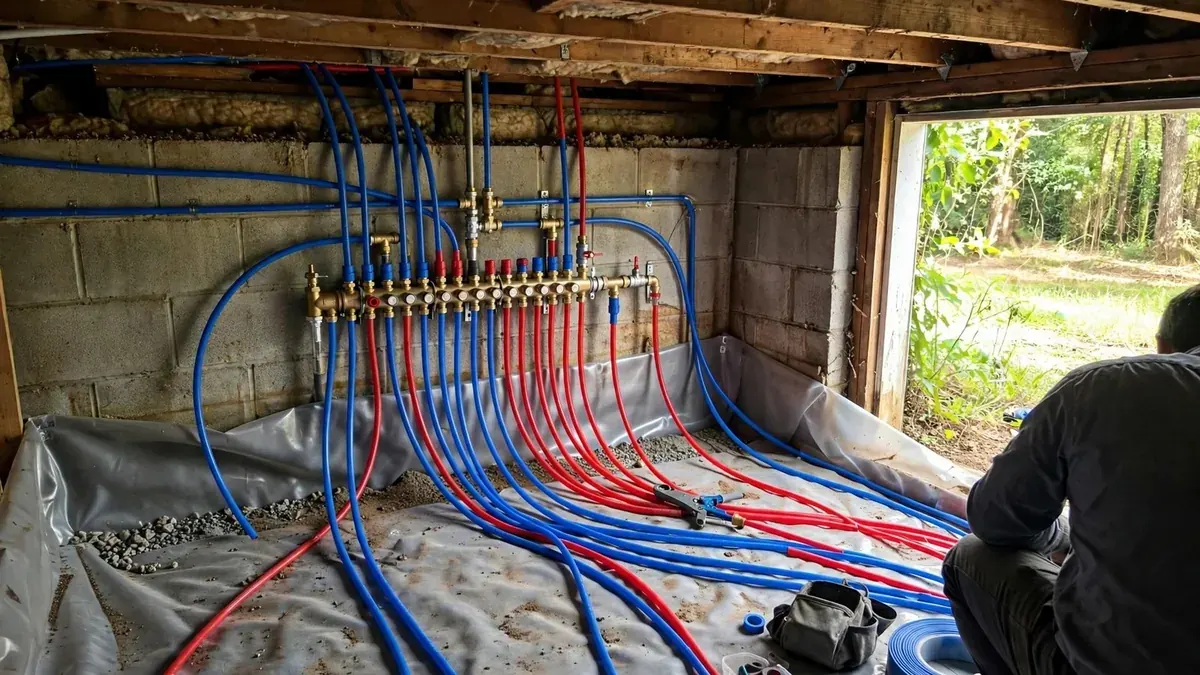
Signs that point to repiping
- Repeated pinhole leaks in copper or galvanized pipe.
- Rusty or discolored water from several taps.
- Weak flow that gets worse over time.
- Visible green or white crust on joints.
- A history of leaks in more than one place.
- Discovery of an old pipe type during a remodel.
One leak does not mean you need a new house of pipes. A single failed joint can be repaired. A pattern of failures in different spots is the sign of a system near the end of its life.
Pipe materials in homes of different ages
Carol Stream was incorporated in 1959 and its housing was built mainly between the 1960s and 1990s, judging by the village's population growth from 4,434 in 1970 to 31,716 in 1990. Homes of that period may have copper supply, and some older homes anywhere in the region have galvanized steel. A plumber checks the pipe at the meter, the water heater and inside walls to identify yours.
Do not assume. Look at the pipe near the water heater. Copper is a reddish-brown color. Galvanized is gray and magnetic. PEX is flexible, usually red, blue or white. Polybutylene, a gray plastic used in some homes decades ago, has a record of failure and should be identified if present.
The line is staffed around the clock. Describe what is happening and we dispatch a licensed plumber.
Repipe materials compared
| Material | Strengths | Cautions |
|---|---|---|
| Copper | Long record, handles heat, fire resistant | Higher material cost, can pit in aggressive water. |
| PEX | Flexible, quick to install, fewer joints | Not for outdoor sunlight exposure. |
| CPVC | Lower cost, corrosion free | Brittle with age and heat. |
The right choice depends on your house, access, budget and the water. The plumber explains the trade-offs and the code requirements under the Illinois Plumbing Code, 77 Ill. Adm. Code 890, before you decide.
How a repipe works
- The plumber walks the house and marks access points and fixture locations.
- A written plan and price are reviewed and approved.
- Water is shut off in stages and old lines are cut out.
- New lines are run, fixtures reconnected and the system pressure tested.
- Small drywall openings are patched or left ready for a drywall trade.
Most whole-house repipes take a few days. Water is usually restored each evening. Ask whether drywall repair and paint are included in the quote or if you need a separate trade.
Partial repipes and alternatives
A section such as the line to a second bathroom, the kitchen, or the water heater manifold can be repiped without the whole house. Spot replacement of an old section often solves a recurring leak at much lower cost.
If you are not sure whether the source is a pipe or a fitting, start with leak detection. If the problem is outside the house, see water line repair.
Planning the cost
You receive the plan and price in writing before any pipe is cut.
Repiping questions
How do I know if I need a full repipe?
A pattern of leaks, rusty water and low pressure across the house points to it. A single leak does not.
How long does a repipe take?
Most homes take a few days, with water restored each evening. Larger or finished homes may take longer.
Will repiping damage my walls?
Some small openings are usual. The plumber discusses where they are and how they are patched.
Do I need a permit for repiping?
Permit rules vary, so ask the Village of Carol Stream building staff. The plumber can describe the usual process.
Can I repipe only part of the house?
Yes. A partial repipe is common when only one section is failing.
Standards and sources
Plumbing work in Illinois follows the Illinois Plumbing Code, 77 Ill. Adm. Code 890, and plumbers are licensed by the Illinois Department of Public Health under 225 ILCS 320. Local water facts come from the Village of Carol Stream 2025 water quality report and the DuPage Water Commission FAQ. These are the standards and sources we rely on, and anything we could not verify is left out.