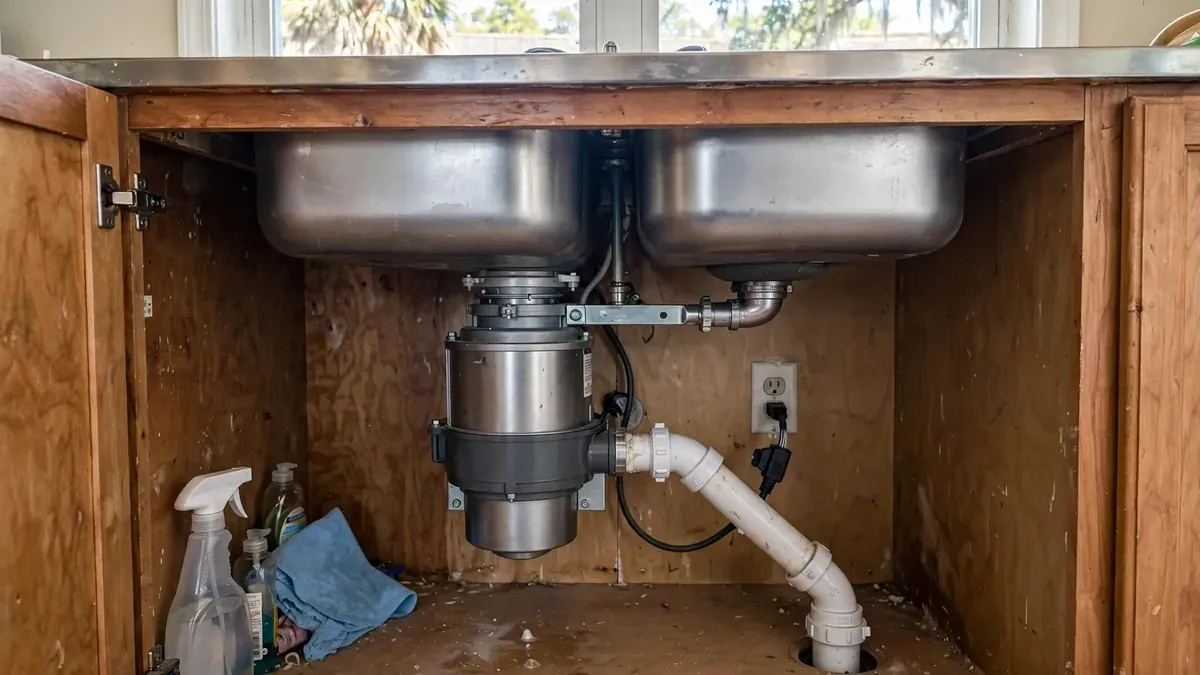
Humming but not grinding
A disposal that hums and does not spin is jammed. Cut the power at the wall switch and the breaker. Then look underneath for a hex socket in the center of the motor housing. A hex wrench turned back and forth frees most jams. Press the red reset button on the base afterward.
Never reach into the grinder, even if the power is off. Use tongs or pliers to remove an object you can see. If the unit hums again, or the reset trips repeatedly, the motor or the bearings may be failing, and replacement may be the answer.
Leaks: where the water is coming from
| Where it leaks | Likely cause | Typical fix |
|---|---|---|
| Top, at the sink flange | Dried plumber's putty or loose mounting | Reseat the flange. |
| Side, at the dishwasher hose | Loose clamp or cracked inlet | Tighten or replace the hose. |
| Bottom of the unit | Failed seal, shell cracked | Replace the disposal. |
| Drain pipe connection | Loose gasket or nut | Reseal the joint. |
Water from the bottom of the body means the internal seal has failed. That cannot be repaired. The only fix is a new unit, and delay risks cabinet damage and mold.
The line is staffed around the clock. Describe what is happening and we dispatch a licensed plumber.
Slow drains and clogs in the sink
If the sink drains slowly when the disposal runs, the trap or the line beyond it may be partly blocked. Grease and starchy waste such as rice and potato peels are the usual causes. Fibrous foods such as celery and corn husks wrap around the shredder.
A disposal does not clear a clogged drain. If the water backs up into the other side of a double sink, the line needs drain cleaning, not a new disposal.
Choosing a replacement unit
Horsepower, feed type and noise insulation separate the models. A continuous-feed unit with a 1/2 horsepower motor suits light use. A larger motor handles heavier loads and runs quieter. Batch-feed units run only when a stopper is in place, which some households prefer for safety.
Installation includes a new mounting kit, a new drain connection, an electrical connection and a dishwasher knockout opening if a dishwasher is connected. The old unit is hauled away.
What never belongs in a disposal
- Cooking grease and oil.
- Coffee grounds in quantity.
- Pasta, rice and potato peels.
- Bones, fruit pits and shells.
- Fibrous vegetables such as celery stalks.
- Glass, plastic or metal.
A disposal protects the sink from small food scraps. It does not turn the kitchen drain into a trash chute, and the line beyond it pays the price. Many Carol Stream kitchens were built decades ago with narrower drain lines than newer ones, so be gentle.
Quoting repair or replacement
For fixture problems nearby, see faucet and sink repair.
What to do before the plumber arrives
- Switch off the disposal at the wall switch and the breaker.
- Never put a hand into the chamber.
- Stop running the dishwasher if the sink backs up.
- Move cleaning supplies out of the cabinet.
- Wipe up water to prevent slips and cabinet damage.
These steps take two minutes and protect you and the cabinet while help is on the way.
Garbage Disposal Repair and Installation questions
Do you handle garbage disposal emergencies at night or on weekends in Carol Stream?
Yes. The line is open 24/7, and the dispatcher arranges a plumber, same day when available.
Can a jammed disposal be fixed without replacing it?
Often yes. Most jams clear with a hex wrench and a reset. A leaking body cannot be repaired.
Is it safe to run a disposal that leaks?
No. Turn it off and shut off the water to the sink until it is repaired.
How long does a disposal last?
Many last about eight to fifteen years, depending on use and what goes in.
Do I need an electrician to replace it?
A plug-in swap is usually a plumber's job. If the circuit needs work, the plumber will tell you.
Standards and sources
Plumbing work in Illinois follows the Illinois Plumbing Code, 77 Ill. Adm. Code 890, and plumbers are licensed by the Illinois Department of Public Health under 225 ILCS 320. Local water facts come from the Village of Carol Stream 2025 water quality report and the DuPage Water Commission FAQ. These are the standards and sources we rely on, and anything we could not verify is left out.