What non-condensing means
Every gas tankless heater burns gas to heat water in a heat exchanger. A non-condensing unit vents hot exhaust straight out, so water vapor stays a gas. A condensing unit has a second exchanger that pulls more heat from the exhaust and cools it to the point where vapor turns to liquid.
That liquid is acidic, which is why condensing models need a plastic vent and a condensate drain. Non-condensing units use stainless steel venting and need no drain.
Side by side
| Feature | Non-condensing | Condensing |
|---|---|---|
| Efficiency | Lower, around the mid 80 percent range | Higher, in the 90s percent. |
| Vent material | Stainless steel | PVC or similar plastic. |
| Condensate drain | Not needed | Required. |
| Upfront cost | Usually lower | Usually higher. |
| Install flexibility | Needs a hot-rated vent | Easier vent routing, needs a drain. |
Efficiency figures vary by model, so read the label. The difference matters more for a large household with heavy hot-water use than for one or two people.
Call the 24/7 line and describe the problem. A dispatcher sends a licensed plumber.
When non-condensing makes sense
- You are replacing an older unit with an existing steel vent in good condition.
- The house has no easy path for a condensate drain.
- The budget favors lower upfront cost.
- Hot-water use is modest.
A non-condensing unit is not a bad choice. It is the right choice in some homes and the wrong one in others. A plumber who explains both options is more useful than one who recommends only the more expensive.
Gas line, vent and electrical checks
A tankless heater needs a gas line sized to the burner's input, often larger than the line a tank uses. It also needs a vent route to the outside that follows the manufacturer's clearances, and electric power for the controls.
If the gas line is undersized, the heater will not reach full output. A plumber checks the pipe size, the meter and the run length before you buy. See tankless water heater and water heater installation for how a quote is built.
Water quality and maintenance
Scale reduces performance in any tankless heater. Condensing units have extra surfaces to protect. In harder water, a yearly flush with a descaling solution is common practice, and a water treatment plan helps.
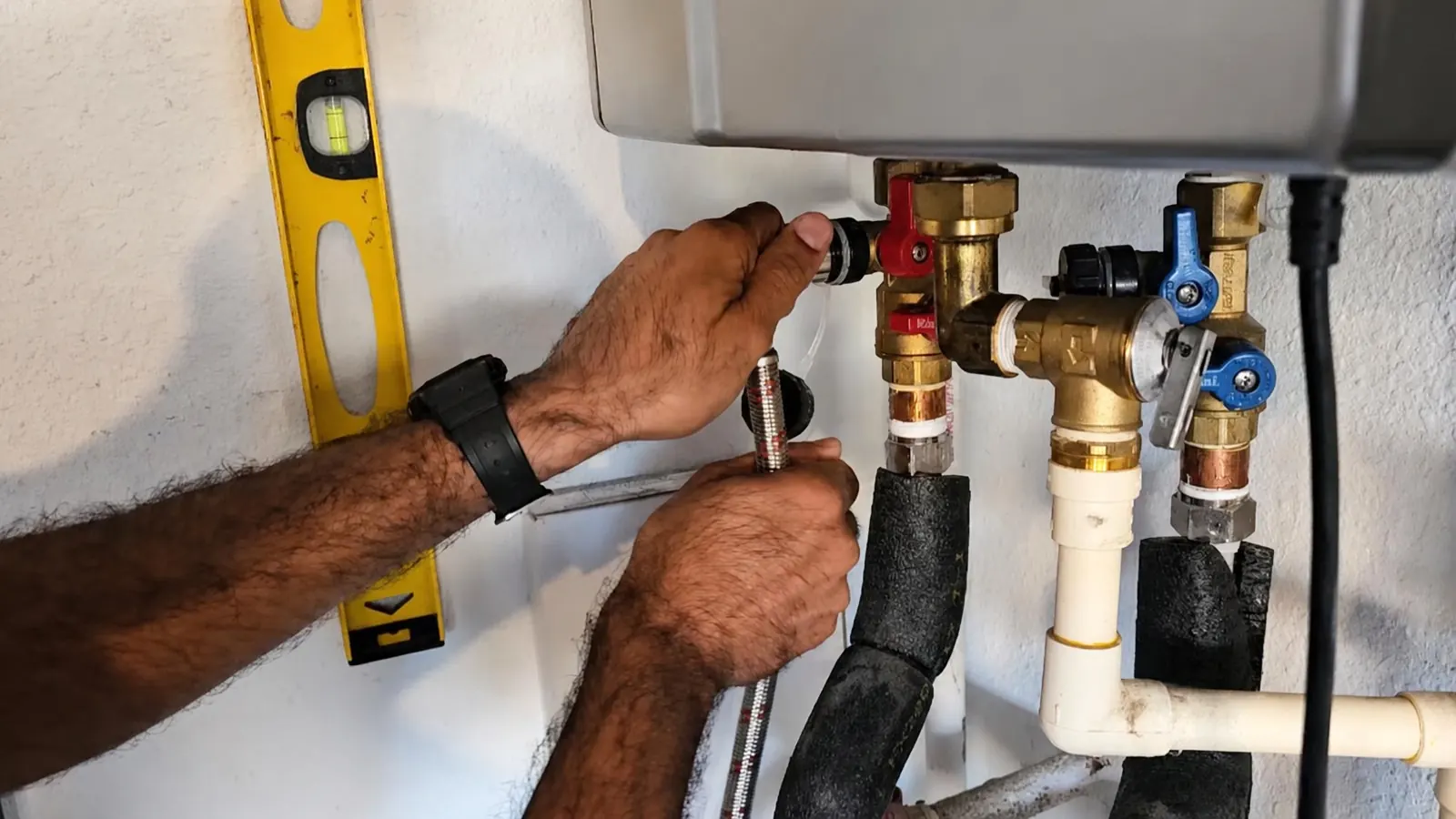
Ask your plumber to install isolation valves with service ports. They make flushing quick, and without them it is much harder to maintain the unit.
Costs and payback
Payback depends on use and gas price. For a small household it can take many years. For a large one it comes sooner.
Sizing for flow, not just size of house
Tankless heaters are rated in gallons per minute at a given temperature rise. A shower uses about two gallons a minute, a dishwasher a little over one and a kitchen faucet one or two. Add up the fixtures that may run together.
If the unit cannot keep up, the water temperature drops when a second fixture opens. Two smaller units or a higher-capacity model can solve that. A plumber works through this list with you before quoting.
Venting rules you should know
A non-condensing unit's exhaust is hot, so it needs a vent rated for it, with the clearances the manufacturer lists from windows, doors and property lines. Venting can run through a wall or the roof.
Do not reuse an old water heater flue without checking that it suits the new unit. Mismatched venting is a safety problem, not a cosmetic one.
Questions to ask before you buy
- What is the rated flow at the temperature rise I need in winter.
- Is the vent included or priced separately.
- Does the price include a new gas line if one is required.
- What warranty covers the heat exchanger and parts.
- How is the unit flushed and does it have service valves.
Prices that look cheap sometimes leave out the vent or the gas line, which are major parts of the job.
Electric tankless as an alternative
Electric tankless heaters need no vent and no gas line, which makes them easy to place. They draw heavy current, often 40 to 150 amps in total for a whole-house unit, and many older panels cannot supply that without an upgrade.
Smaller point-of-use electric units serve a single sink or shower and need much less power. A plumber and an electrician can work out which fits your house.
Common installation mistakes
- Undersized gas line.
- Vent run longer than allowed.
- Skipping isolation valves.
- Ignoring clearances to combustibles.
- Not setting the unit for the elevation or fuel.
A qualified installer avoids these. Ask what they check before they start.
Warranty and service life
Heat exchanger warranties on tankless units are often long, but they can depend on water quality and annual maintenance. Read the terms for flushing requirements, venting rules and installer qualifications.
Keep the receipt and the installation record. If you ever need a warranty claim, the company will ask for both.
Choosing in nearby towns
The same venting and gas line questions apply in Bloomingdale and Hanover Park, where houses of different ages need different solutions.
A plumber who looks at your meter, your vent route and your usage will give a better answer than a general rule.
Carol Stream water and the heat exchanger
Carol Stream's 2025 water quality report says the village buys Lake Michigan water through the City of Chicago and disinfects it with chlorine. The report lists no hardness figure.
The DuPage Water Commission describes its lake water at about 8 grains per gallon, a commission statement rather than a village one. Moderately hard water leaves scale on a heat exchanger over time, so ask the plumber about isolation valves and a yearly flush.
Questions readers ask
Which tankless type is better for Carol Stream homes?
It depends on the home. Condensing is more efficient, and non-condensing can be simpler to fit.
Do tankless heaters work during a power outage?
Most need electricity for controls, so they stop without power.
How long do tankless heaters last?
Many manufacturers advertise around twenty years with maintenance. Water quality affects this.
Do I need to upgrade the gas line?
Often yes. The plumber checks pipe size and run length.
Can I install one myself?
Gas and venting work should be done by a qualified professional.
Standards and sources
This guide follows the Illinois Plumbing Code, 77 Ill. Adm. Code 890, and general manufacturer guidelines for the equipment discussed. Local facts come from the Village of Carol Stream, the DuPage Water Commission and the Daily Herald, as named in the text. Product instructions for your own equipment always take priority over general advice.